Impeachment or GNU?: Hill-Lewis says no trade-off for accountability in government

DA leader Geordin Hill-Lewis says there is no trade-off for accountability in government (Camera & editing: Nicholas Boyd)
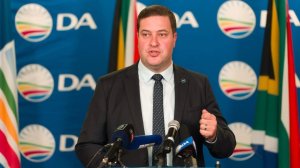


Despite being in a crucial coalition alliance with President Cyril Ramaphosa’s African National Congress (ANC), Democratic Alliance (DA) leader Geordin Hill-Lewis is clear that there will be no trade-off for accountability or integrity in government under his leadership.
Speaking exclusively with Polity about the DA’s policies and political developments in South Africa ahead of the 2026 municipal elections, Hill-Lewis said there was no balance being sought between his party’s commitment to accountable governance and its role as a Government of National Unity (GNU) partner.
This as Ramaphosa faces the possibility of impeachment as the National Assembly initiates a process to establish an Impeachment Committee after the Constitutional Court found that the previous parliamentary vote, which halted an impeachment inquiry against Ramaphosa, violated the National Assembly’s constitutional obligations under Section 89 of the Constitution.
When asked about the DA’s position on the matter, Hill-Lewis said his party’s vision of building a successful country was much bigger than government.
“[It] isn't just about me. It's not about the President. It's not about this government. It's bigger than all of us. And so we have to stand very firmly for some of the principles on which successful societies are built. And one of them is accountability and integrity in the State.
“And so that's not something that we will trade off, not for political convenience, not ever. And so if it comes to that, you know, I've made it clear that we will participate fully in the Impeachment Committee, but we will not be part of turning a blind eye to wrongdoing,” he said firmly.
And the way in which Hill-Lewis plans to execute his party’s vision for a successful South Africa is through his position in government.
He reiterated his plan to stay on as Cape Town mayor, while heading up the country’s second largest political party, a dual role that he believes he can successfully pull off by being “deliberate and intentional” with his time, splitting off his weekdays in the mayoral office and campaigning for his party on the weekends.
“And I look forward to trying to do both,” he said, noting that as his party grows, those who grew with it would face the same responsibilities.
NOT A ‘WHITE PARTY’
In his dual role as DA leader and Cape Town mayor, Hill-Lewis further aims to leverage his position in government to grow the DA’s voter base, with a focus on those who have previously not voted for the party, owing to what he describes as “literally two decades or more of propaganda about what the DA will do when we get into government and who we will govern for…”
He acknowledged that expanding the DA voter base was the party’s biggest challenge, and one that he had committed himself to working on over the next few years.
“…the most important leverage is your position in government, actually. So, you know, that's one of the reasons I thought it was important to stay [as mayor], because I can show very practically on a day-to-day basis that we are governing, I'm governing for everyone, that everyone benefits when the basics work, where cities function and succeed. And in fact, the people that benefit the most are the poorest because they rely on functional public services more than the wealthy,” he rationalised.
He punted the DA’s biggest strength as its track record in governance, while stressing that the DA’s focus was not solely on Cape Town, with the party’s sights firmly set on Johannesburg, Tshwane and Ekurhuleni to prove to South African voters that the DA would work for the benefit of everybody and not just one race.
“Then you start to chip away. You take a 10 pound hammer to that label that, you know, that perception. Similarly with the Government of National Unity. So in the portfolios that we are responsible for, we're not responsible for the whole government, but we are responsible for six portfolios. We must demonstrate in those portfolios that we are meaningfully different,” Hill-Lewis said.
And in the DA’s quest to expand governance into Gauteng, Hill-Lewis assured that competency, not cronyism or cadre deployment, would be the way in which public sector professionals were appointed.
LOCAL GOVERNMENT AND ECONOMY
He pointed to success in the Western Cape in turning around municipalities and when asked about a national strategy for struggling local governments, Hill-Lewis stated that “we cannot turn places around unless we win in those places”.
He asked for a chance from the South African public to show that the DA could fix struggling towns and cities, by focussing on the basics.
Hill-Lewis dismissed the idea of emulating the successes of developed cities globally, noting that South Africa did not have the “time and space” for that.
“We have to just get the basics working, get the water to run, get the electricity to work, upgrade basic and essential infrastructure, fix roads, fix potholes, get the robots to work again. Those are the things that need focussing on first,” he said.
More broadly, the DA’s main focus for growing the national economy lies in more private participation.
Hill-Lewis acknowledged that electricity, transport and minerals exploration were core areas of focus, arguing for the swift breaking of monopolies in these sectors.
“We have to involve private sector management and investment in those big network industries. And quickly… we've been talking about this for a long time, how to break up Eskom, how to break up Transnet, how to get private investment. What matters now is action and urgency. We can't talk about it for too much longer,” he stressed.
Article Enquiry
Email Article
Save Article
Feedback
To advertise email advertising@creamermedia.co.za or click here
Research Reports

Projects


Latest Multimedia
Latest News

Showroom
As one of South Africa's leading manufacturers, Bell Equipment distributes and exports its wide range of heavy equipment globally to mining,...
VISIT SHOWROOM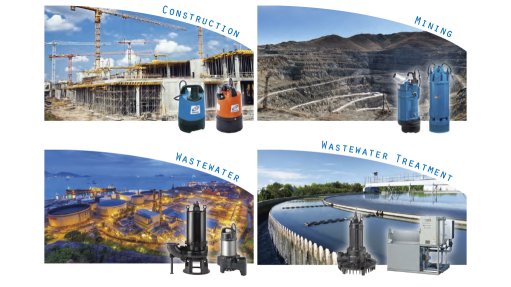
Tsurumi Pumps Africa is a specialist supplier of Japanese-engineered submersible pumping solutions, serving customers across the African continent.
VISIT SHOWROOM
Announcements
What's On
Subscribe to improve your user experience...
Option 1 (equivalent of R125 a month):
Receive a weekly copy of Creamer Media's Engineering News & Mining Weekly magazine
(print copy for those in South Africa and e-magazine for those outside of South Africa)
Receive daily email newsletters
Access to full search results
Access archive of magazine back copies
Access to Projects in Progress
Access to ONE Research Report of your choice in PDF format
Option 2 (equivalent of R375 a month):
All benefits from Option 1
PLUS
Access to Creamer Media's Research Channel Africa for ALL Research Reports, in PDF format, on various industrial and mining sectors
including Electricity; Water; Energy Transition; Hydrogen; Roads, Rail and Ports; Coal; Gold; Platinum; Battery Metals; etc.
Already a subscriber?
Forgotten your password?
Receive weekly copy of Creamer Media's Engineering News & Mining Weekly magazine (print copy for those in South Africa and e-magazine for those outside of South Africa)
➕
Recieve daily email newsletters
➕
Access to full search results
➕
Access archive of magazine back copies
➕
Access to Projects in Progress
➕
Access to ONE Research Report of your choice in PDF format
RESEARCH CHANNEL AFRICA
R4500 (equivalent of R375 a month)
SUBSCRIBEAll benefits from Option 1
➕
Access to Creamer Media's Research Channel Africa for ALL Research Reports on various industrial and mining sectors, in PDF format, including on:
Electricity
➕
Water
➕
Energy Transition
➕
Hydrogen
➕
Roads, Rail and Ports
➕
Coal
➕
Gold
➕
Platinum
➕
Battery Metals
➕
etc.
Receive all benefits from Option 1 or Option 2 delivered to numerous people at your company
➕
Multiple User names and Passwords for simultaneous log-ins
➕
Intranet integration access to all in your organisation